
View Darke ODRC Status Fields
The official ODRC search results interface shows the statewide route used to test a Darke commitment by name, offender number, status, and other available filters.
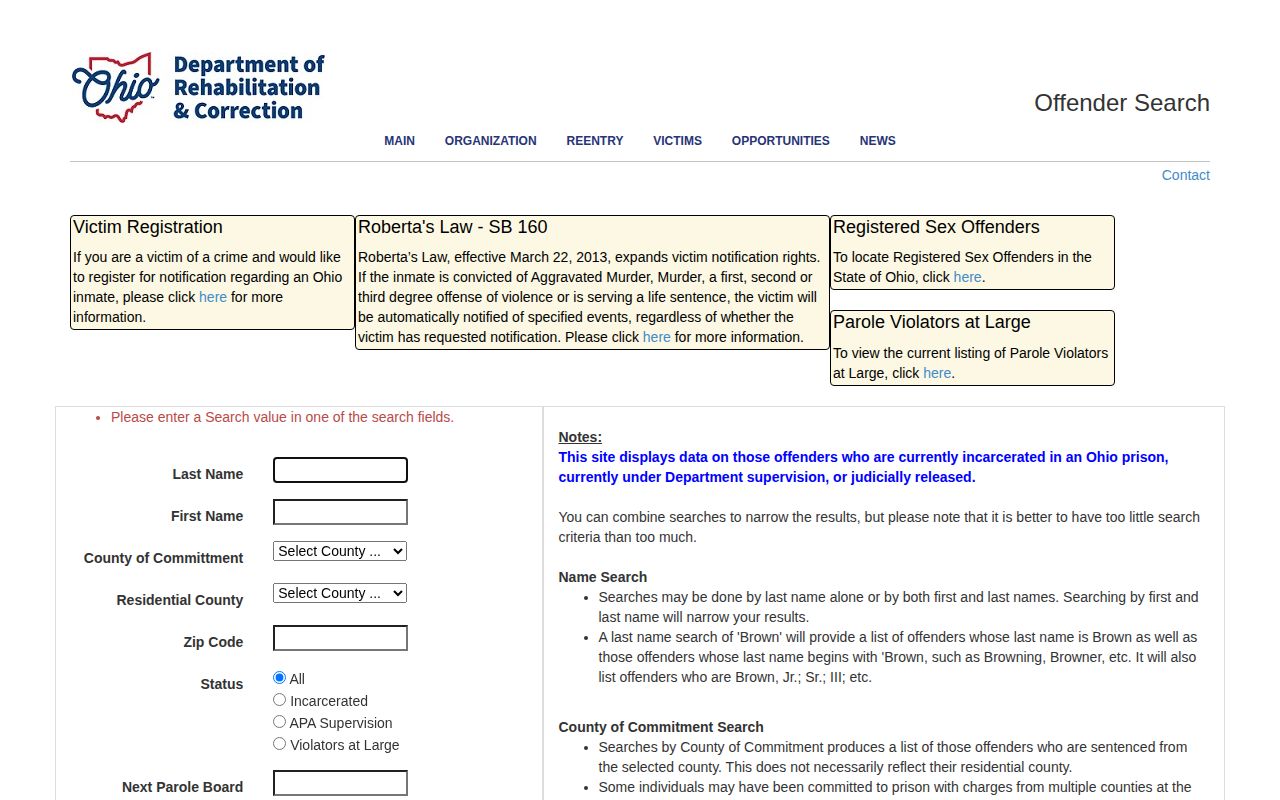
The captured interface supports the search route and its status filters. An individual detail still must be opened and matched before a release conclusion is made.
ODRC also publishes official status and date definitions for interpreting the fields returned on an offender detail.
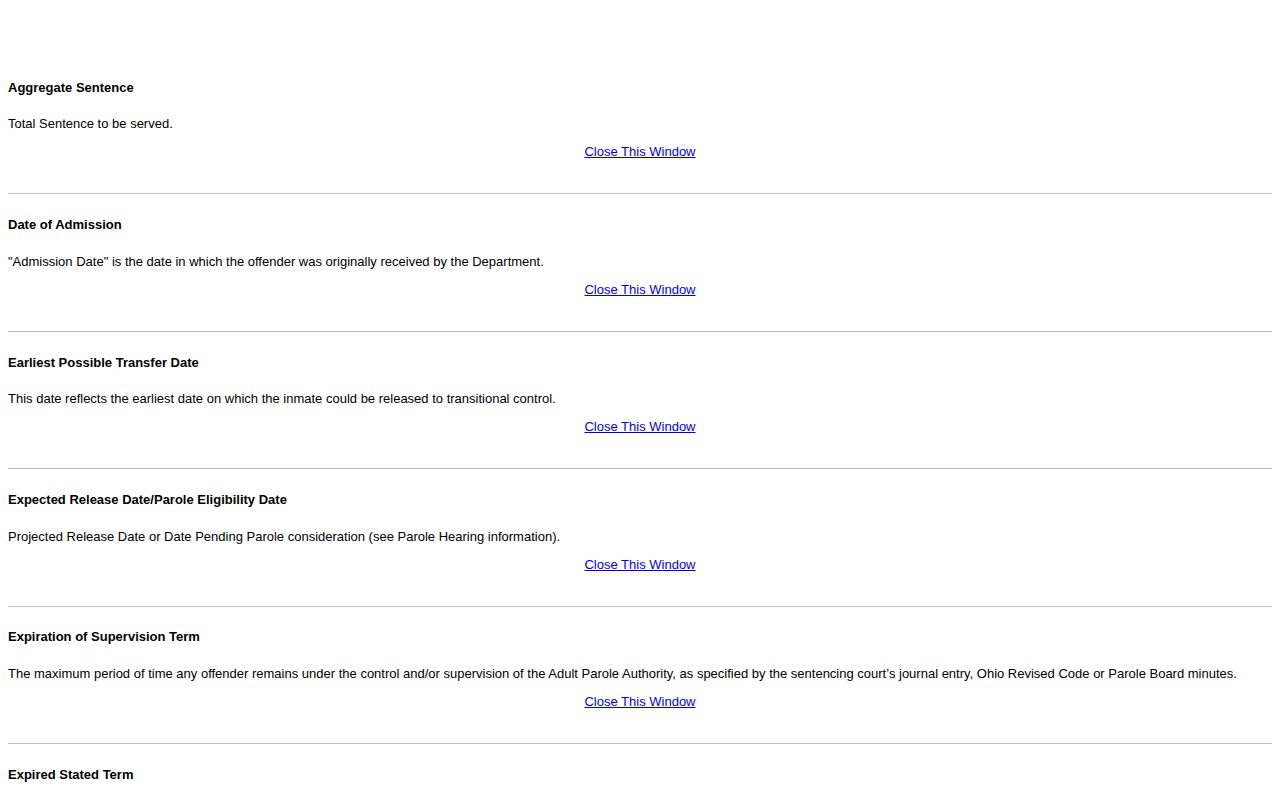
The definitions clarify why a projected or eligibility date is not, by itself, an actual Darke County state-prison release.
Darke ODRC Search Corrections
A mismatch should be corrected with stable identifiers, not broad personal details. Search a known ODRC number first. If only a name is available, test a suffix or spelling change, then use Darke as county of commitment. Residential county is different: it reflects the last recorded county and must not be treated as a present location. The next-hearing-month field identifies scheduling, not release.
When results share a name, compare number, birth date, docket, committing county, admission, and sentence. Save the exact detail supporting the conclusion. If an offense list seems incomplete, respect ODRC’s warning and use the sentencing court record. A corrected court entry, jail-time-credit change, or recalculation may explain why an old date differs. Ask Central Records for the existing calculation or release record instead of attempting a private sentence computation.
Darke ODRC Release Paths
A felony defendant conveyed from Darke County Correctional Facility to ODRC has left county custody but has not been released. The Sheriff transfer record closes the local episode. ODRC admission and institution fields then document state custody. A later prison departure may appear as APA supervision, judicial release, or a released status, depending on the authority and stage of the sentence. Read the status before interpreting any date.
No ODRC prison was identified within Darke County. “County of Commitment: Darke” points to the county case that produced the commitment. It does not locate a prison in Darke or prove that every person booked at the county jail entered ODRC. Ordinary misdemeanor sentences, county bond releases, and many local jail completions may never appear in the state search.
| ODRC status or field | Release meaning |
|---|---|
| INCARCERATED | The person remains in state custody, even if a future date appears. |
| APA SUPERVISION | Prison custody ended and state community supervision began. |
| Judicial Release | The sentencing court authorized prison release into community supervision. |
| Released | Review release detail and discharge fields for the actual event. |
| APA SUPERVISION - VAL | An alleged violator-at-large status requires official warrant verification, not personal contact. |
Search Darke ODRC Release Records
The ODRC Offender Search accepts a last and first name, offender number, county of commitment, residential county, ZIP, status, and next Parole Board hearing month. An offender number is the best key when known. It includes a letter prefix and six digits, often A or legacy R for men and W for women, with leading zeroes. The interface itself advises that fewer criteria can work better.
- Search by offender number. If it is unknown, begin with a minimal name and add Darke as county of commitment only to narrow a broad result set.
- Open the matching detail and compare name, number, date of birth, committing county, docket, and sentence facts.
- Read Status first. Do not treat an expected date, hearing date, or Darke commitment as proof of release.
- For a prison exit, record release detail, supervision start, APA office, POA/PRD, and sentence-expiration or discharge data that apply.
- Compare the ODRC event with the Darke Common Pleas journal entry when the authority was judicial release or another court action.
Darke Prison Record Fields
An ODRC detail can contain much more than a single result line. Relevant fields include the offender photograph, admission, institution, status, offenses, effective sentence date, jail-time credit, sentence components, committing county, docket, judge, aggregate term, expected-release or parole-eligibility date, POA/PRD, hearing result, post-release control, and supervision data. ODRC cautions that an offense list may be incomplete and that a supervision duty can stem from an earlier offense.
- POA Date
- The earliest date for release on APA supervision, meaning parole on or after that date.
- PRD
- Projected release date, still subject to lawful changes and related fields.
- APA supervision
- State oversight after prison release, with start date, office, and period shown when available.
- Discharge
- The end of the sentence or supervision authority, which can occur after physical prison release.
A residential address is last recorded information, not a live location tool. Do not publish it as current whereabouts. If a public detail says violator at large, ODRC directs the public to law enforcement or emergency services and directs officers to verify through official systems.
Darke ODRC Records Contact
When the public detail does not settle the event, request an existing record from ODRC Central Records. Supply the full name, ODRC number, Darke committing county, docket, and date range. Ask for the release, parole, or discharge record; actual release or supervision-start date; release authority or type; releasing institution; sentence expiration or discharge; APA office; and final Parole Board minute when relevant. The office need not create a new analysis.
ODRC Central Records
Ohio Department of Rehabilitation and Correction
Attn: Central Records
P.O. Box 430
Columbus, OH 43216
Public route: ODRC Offender Search
Darke court route: Common Pleas sentencing and release entries
Ohio Revised Code 5120.21 permits disclosure of specified name, conviction, photograph, supervision status, current or past incarceration, and disciplinary history while keeping other inmate-file material confidential. Ohio’s public-record law remains subject to exceptions and redaction. A narrow request tied to one offender and event is easier to verify.
Darke Prison Dates Explained
The expected-release or parole-eligibility label is deliberately combined. For a definite term it may reflect a sentence calculation. For a parole-eligible or life term it may identify only the point when the Board may consider release. POA means parole on or after, while PRD means projected release date. Transitional-control and sentence-expiration fields describe other stages and must not be substituted for actual departure.
Ohio has no universal rule that every prisoner serves 85 percent. ORC 2967.194 creates provisional earned-credit paths for eligible people and terms, with exclusions, caps, program requirements, and ODRC review. Credits can be denied or withdrawn. Other sentences follow parole law, indefinite-sentence rules, mandatory terms, consecutive parts, or older regimes. Court correction, jail credit, discipline, Board action, another hold, and transitional-control decisions can change a projection.
| Evidence | What it proves |
|---|---|
| Future expected date | A current projection or eligibility point, not completed release |
| Favorable hearing result | A Board action that still must be read with POA/PRD and status |
| Supervision start | Strong evidence that prison custody ended into APA oversight |
| Final discharge field or record | The later end of the applicable state authority |
Darke Court and APA Proof
Darke County Common Pleas is the durable court source for felony sentencing, conveyance, judicial release, community control, revocation, and termination. A judicial-release entry proves what the court ordered. ODRC status and supervision start show execution of the prison event. Pairing them prevents an authorization date from being mistaken for the day the person physically left custody.
APA supervision belongs to ODRC. Darke County Adult Probation instead supervises court-ordered community control. A person released straight from the local jail to county probation may never show as APA-supervised. Conversely, APA supervision can continue after departure from an ODRC prison. The Darke County parole and probation record paths distinguish those offices and fields.
After a date passes, current status is stronger than an old screenshot. Record the access date, exact status words, event date, offender number, and source. If ODRC still says incarcerated, do not report a prison release. If it says APA supervision, note the start and office. If it says released without enough detail, ask Central Records for the existing release and discharge documentation.
Darke State Release Boundaries
ODRC is not the county jail, BOP, ICE, or the U.S. Marshals Service. A Darke jail transfer to a federal or immigration custodian will not become an ODRC record merely because the event began in the county. Federal sentences use BOP. ICE uses its detainee locator. USMS pretrial custody is traced through federal court and agency records.
Likewise, a missing ODRC result does not prove community release. The person may have a name variation, no state-prison history, an older or restricted record issue, or custody in another system. Use only enough identifiers to distinguish the record. Keep the inquiry focused on agency status, documented release, supervision, and court process. Confirm every result with the office that created it when accuracy matters.