
Darke Scheduled and Actual Release
A scheduled or expected date is prospective. It is calculated from the sentence information then known and can change before the person leaves. An actual release date records a completed custody event. Ohio’s public label can also combine release projection with parole eligibility, which requires more care than a simple calendar lookup.
Scheduled versus actual: Treat a future date as a planning field. Confirm release afterward through current status, release detail, supervision start, and the custody or court record.
| Date or status | Meaning | Best confirmation |
|---|---|---|
| Expected Release Date/Parole Eligibility Date | A projected exit or a date when Board review may begin | ODRC status, sentence, and hearing fields |
| POA Date | Earliest parole-on-or-after date | Board result and actual APA start |
| PRD | Projected release date | Later ODRC release or supervision detail |
| Supervision Start Date | Evidence that state-prison release into APA supervision occurred | ODRC detail and Central Records |
| County jail calculation | Local term based on the entry and jail-time credit | Sheriff and sentencing court record |
An ODRC page that still says INCARCERATED outweighs a casual reading of the future date. Eligibility also never guarantees release.
Find a Darke Inmate Release Date
Begin with the exact facility. The Darke County Correctional Facility is a local jail, not an ODRC prison. No state prison sits inside Darke County, although people sentenced in its courts can enter ODRC. Federal and immigration dates belong to separate systems.
- Check whether the person appears on the Darke current-custody roster or in ODRC. Match the name with a booking, offender number, date of birth, or court case.
- For a county sentence, obtain the sentencing entry and ask the Jail Division or Sheriff Records for the existing computation, including jail-time credit and holds.
- For a state prisoner, open the ODRC Offender Search. Search by offender number when possible, or begin with a minimal name.
- Read Status first. Then review sentence components, jail-time credit, expected-release/parole-eligibility, POA/PRD, hearing results, and transitional-control fields.
- Recheck after the projected day. Confirm actual release through status, release detail, supervision start, the court, or ODRC Central Records.
A pretrial Darke County detainee normally has no fixed sentence-expiration date. Bond, dismissal, a plea, trial, sentencing, or another hold can control the next custody event. The Municipal or Common Pleas docket is more relevant than a state earned-credit calculation in that setting.
The Darke County release search explains how to trace a person who has left the local roster, including transfer rather than community release.
Darke ODRC Release Date Fields
ODRC’s precise public field is Expected Release Date/Parole Eligibility Date. The agency defines it as a projected release date or a date pending parole consideration. The combined wording is deliberate. For a definite sentence it may reflect a projected expiration calculation. For an older indeterminate or life sentence, it may only mark when Ohio Parole Board consideration can occur.
The official ODRC definitions explain the status and date terms used in an Ohio state-prison record.
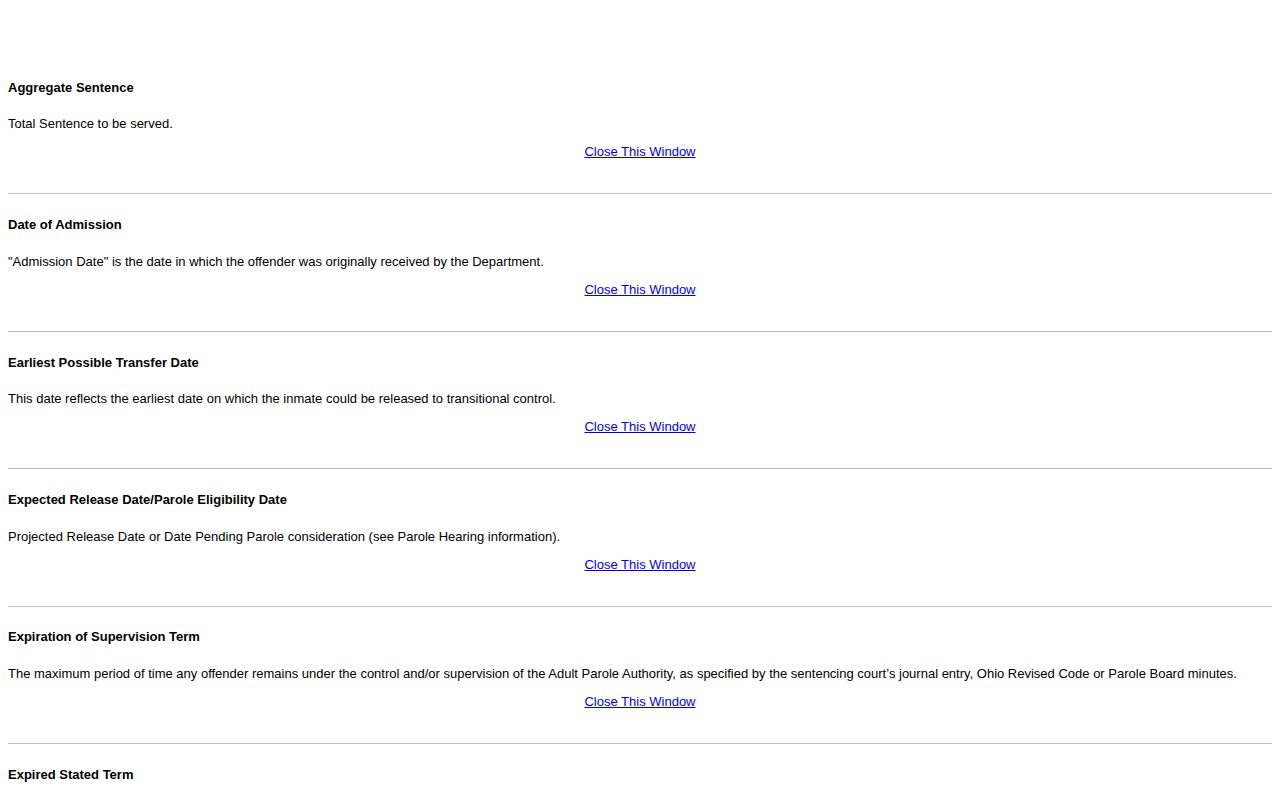
These definitions show why the date must be read with status, sentence type, and any Board action.
Related fields can refer to different stages. Earliest Possible Transfer Date concerns transitional control, not final discharge. TC/TT Sentence Expiration is a projected date from halfway-house status. Expired Stated Term concerns the court-imposed term after jail credit. An APA office and supervision start can corroborate release into the community, yet state supervision may continue.
ODRC also cautions that the offense list may be incomplete and a supervision duty can stem from a prior offense. Stable identifiers and the court docket reduce the risk of reading the wrong sentence.
Read Darke Projected Release Results
One official ODRC example displays INCARCERATED with a future Expected Release Date/Parole Eligibility Date, future supervision information, and a review result. That combination proves the public date does not by itself establish that prison release was granted or completed.
The ODRC incarcerated example provides the matching field layout.
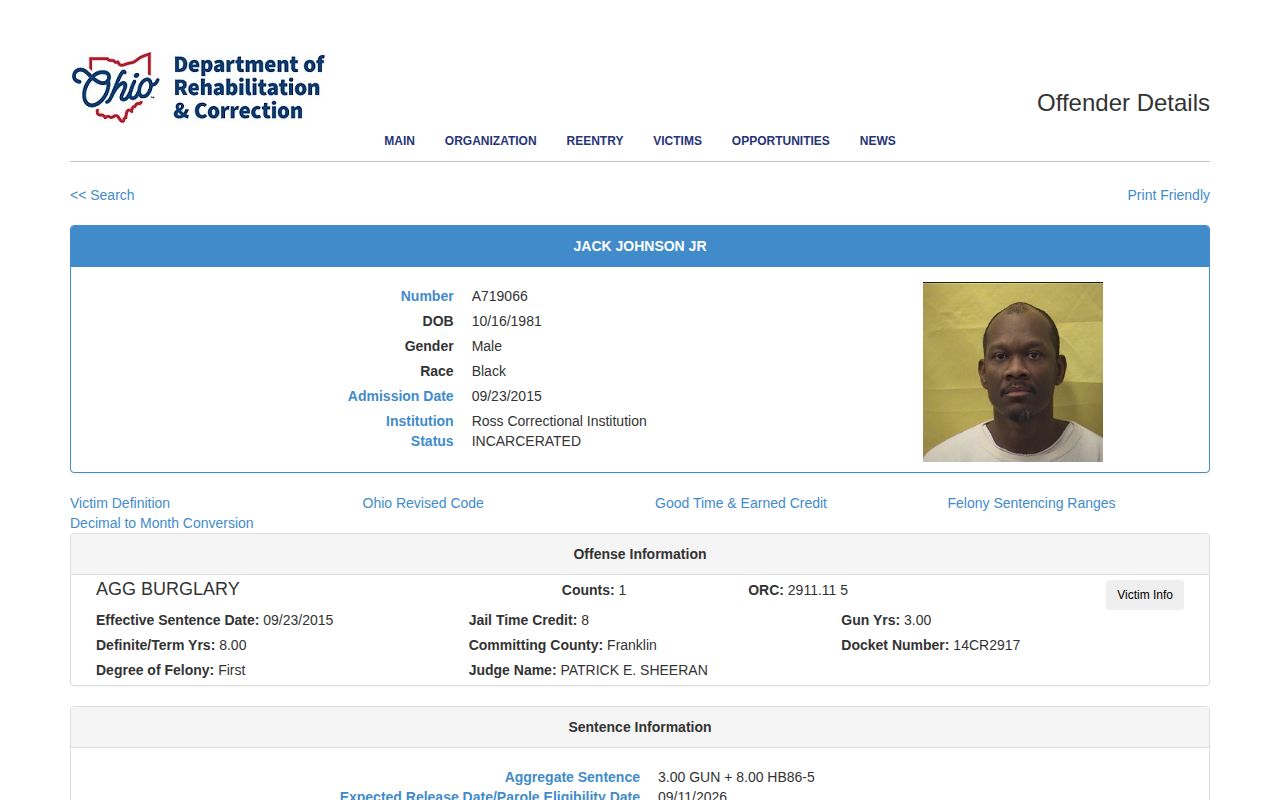
The status at the top and the sentence details below keep a future date from being mistaken for an actual release.
- Definite sentence
- A term with a stated duration, subject to the judgment and governing law.
- Indefinite sentence
- A sentence with minimum and maximum terms or parole-based rules.
- Parole eligibility
- The point at which Board consideration may occur, not guaranteed release.
- Jail-time credit
- Qualifying time already served that is credited toward a sentence.
- Detainer
- A request or hold that can prevent community release to another authority.
Darke State Release Earned Credit
Current ORC 2967.194 applies, with transition rules, to covered people confined on or after April 4, 2024 in a state correctional institution or specified treatment program. Eligible activity can provisionally earn one or five days for a completed month depending on category. A second qualifying activity can add up to five more days. Listed diploma or program completions can produce 90 days or ten percent of the stated prison term, whichever is less, under their rules.
Most of the participation and completion credits are subject to an aggregate cap of fifteen percent of the stated term, except the statute’s separately treated completion credits. Credits remain provisional until ODRC review. Rule violations can lead to denial or withdrawal. Many sentences are excluded, and mandatory or consecutive parts can remain unaffected.
The Ohio earned-credit statute is the controlling source for its categories, caps, exclusions, and review rules.
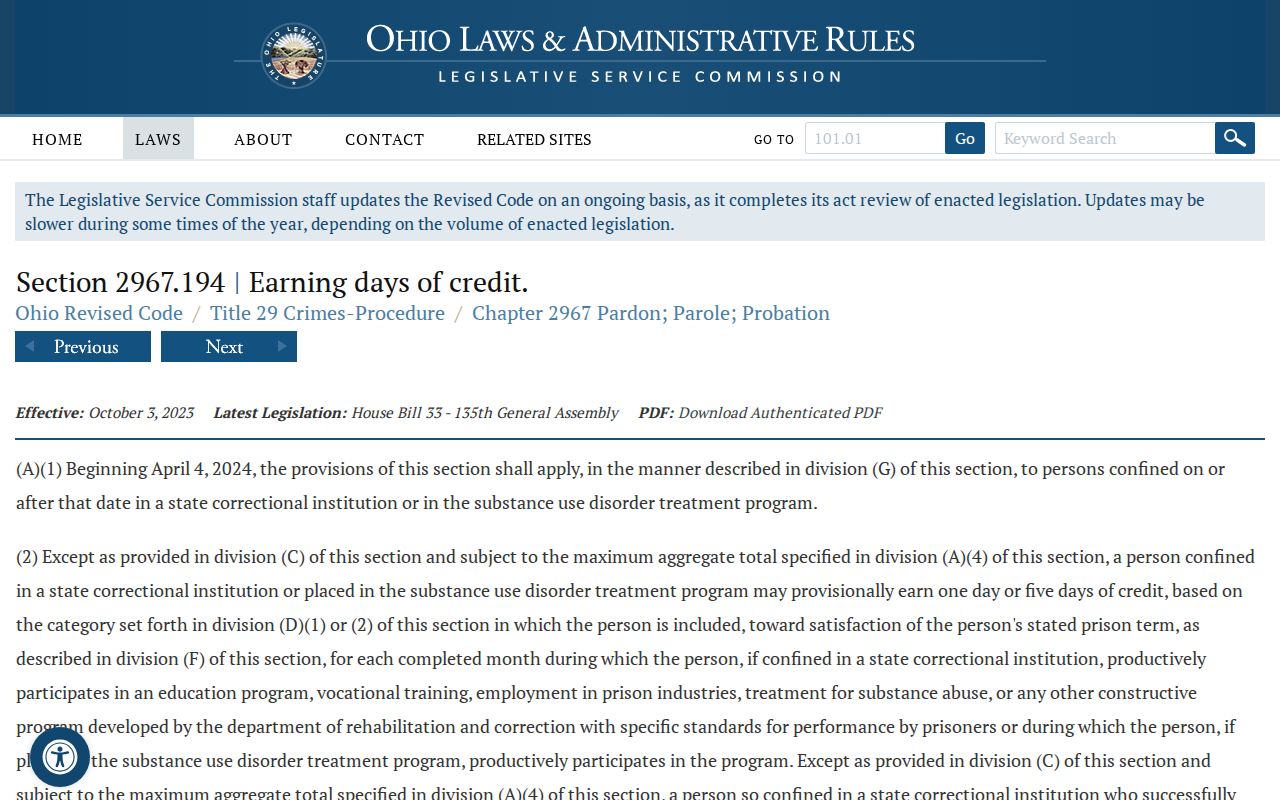
The statute’s detailed conditions show why no single percentage should be applied to every Darke County commitment.
Note: Earned credit can alter a qualifying state term, but it does not automatically govern a sentence served in the Darke County jail.
No Universal Darke 85 Percent Rule
Ohio does not have a universal rule that every prisoner serves eighty-five percent. Fifteen percent is an aggregate cap for specified credits on some eligible terms. Subtracting that cap is only rough arithmetic for a subset of cases, not a lawful release prediction. Some people earn no credit. Some completion credits use another limit. Older sentences follow other regimes.
Parole terms require Board action. ORC 2967.13 sets eligibility for specified life and older parole-eligible terms, and consecutive components can affect the first review point. ORC 2967.271 governs qualifying indefinite sentences with minimum, maximum, presumptive earned early-release, and possible continued-confinement provisions. Mandatory terms and specifications may also resist reduction.
The safe approach is record-based. Use the sentence, jail credit, ODRC computation, Board result, and status. Do not promise an exit from a hand calculation.
Darke County Jail Release Computation
County-jail sentences follow the sentencing entry, credited time, and the Sheriff’s calculation. The state framework includes a separate ODRC sentence-computation rule, while ODRC earned credit does not automatically apply to a local jail stay. No official Darke County policy was found that promises local good time, a routine early-weekend release, a fixed discharge hour, or one standard reduction. Importing a state-prison percentage into a local sentence would give a false result.
Darke County Release-Date Contacts
Darke County Correctional Facility
5185 County Home Road
Greenville, OH 45331
Jail Division: 937-548-2020 option 2
Roster line: 937-548-3399
Ask for the existing calculation or booking/release record and cite the court case. The sentencing court can provide the judgment and later orders. The Sheriff can address the custodial calculation and whether another hold exists. Neither should be asked to estimate from facts not yet in the file.
A bond authorization also does not set a firm door-out time. Payment, processing, conditions, and other holds can intervene between the court event and physical exit.
Why Darke Release Dates Change
Projected dates move because the inputs or legal authority change. Recheck the current source after any court, disciplinary, parole, or custody event.
| Change | Possible effect | Record to review |
|---|---|---|
| Earned-credit approval or withdrawal | Moves a qualifying state projection | ODRC computation and ORC 2967.194 decision |
| Jail-time credit correction | Changes credited days in the term | Sentencing entry and computation |
| Board continuance or decision | Moves or resolves a parole review | Hearing result and final Board minute |
| Judicial release or revocation | Moves the person between prison and supervision | Common Pleas journal entry and ODRC status |
| Detainer or other hold | Can route the person to another custodian | Release sheet and receiving-agency record |
| Transitional control decision | Approves, denies, or changes a staged transfer | ODRC transitional-control fields |
After the projected day, a current status plus release or supervision detail is stronger than an older screenshot. When online fields remain unclear, request the existing calculation, final court entry, or Board minute from the responsible office.
A person who moves from Darke County custody to ODRC has been transferred, not released. A person who leaves prison for APA supervision has been released from prison but not discharged from state oversight. Those distinctions keep the date tied to the correct legal event.
ODRC Central Records is the fallback when the public detail does not explain the calculation. Address a request to Ohio Department of Rehabilitation and Correction, Attn: Central Records, P.O. Box 430, Columbus, OH 43216. Include the full name, ODRC number, Darke commitment, docket, and approximate dates. Ask for the existing release, parole, discharge, or sentence-computation record, along with a final Board minute when that document controls the result.
For a local term, direct the equivalent question to the Sheriff and sentencing court. The jail can identify its calculation and the close of the custody episode. Municipal or Common Pleas records supply the sentence, bond, judicial-release, revocation, or correction order. If the record says transfer, continue with the named receiving agency. The county jail’s roster cannot prove a later state, federal, or immigration release.
Always record the query date. A projection saved weeks earlier may predate credit review, a corrected entry, a Board continuance, or a new hold. The current official detail and the final record control.
When parole eligibility controls the date, request the final Ohio Parole Board minute if the public result is unclear. The Ohio hearing and projected-date rule supplies the formal framework. A hearing type, recommendation, or continued review does not establish an exit. Match the minute to the ODRC number, POA/PRD field, current status, and any later supervision start before calling the date an actual release.
Public Record Search
Sponsored Results